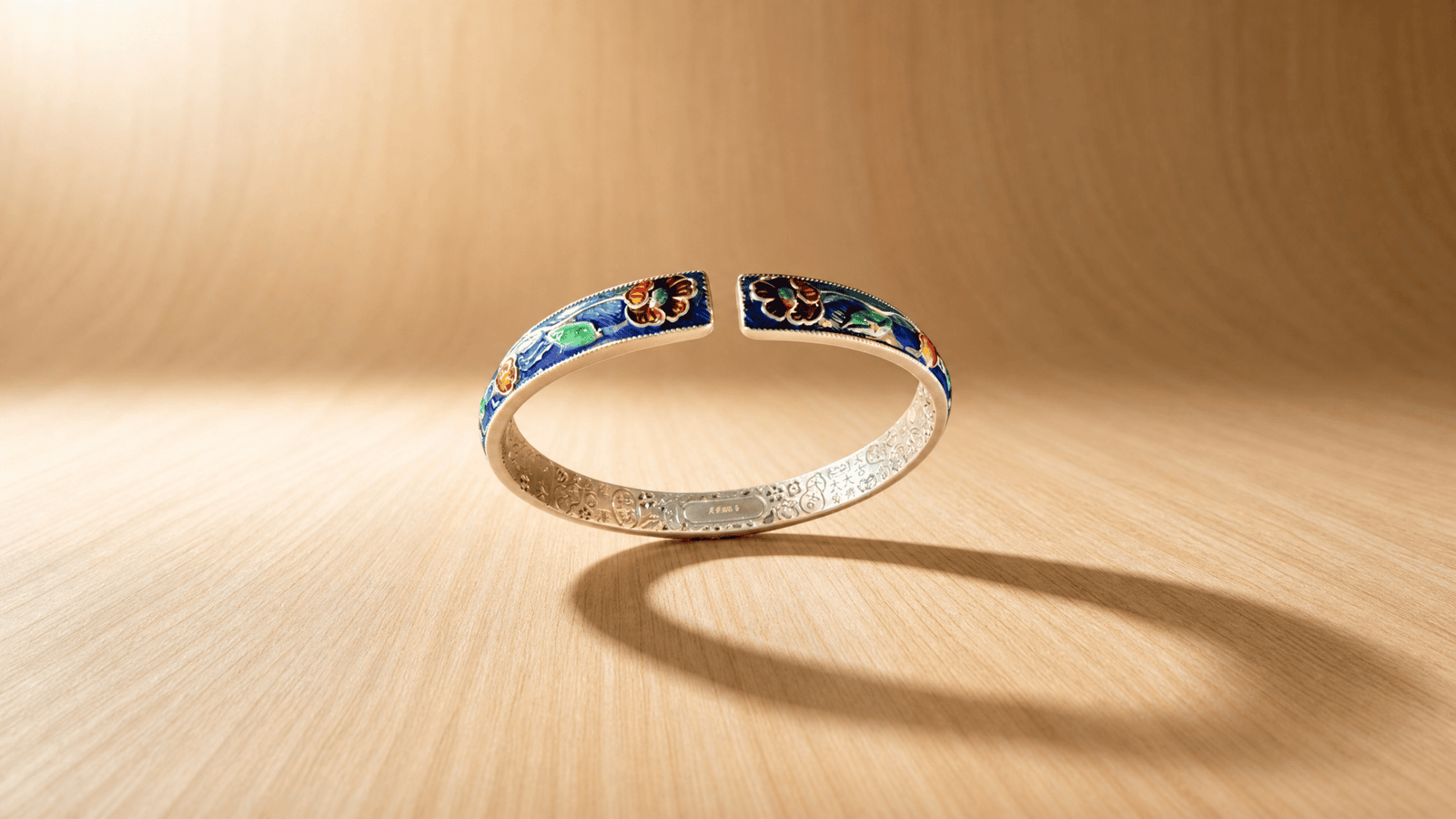
Cloisonné is an enamel technique in which thin metal wires form the boundaries of small cells. The wires are shaped into a design and fixed to a metal base, then each compartment is filled with coloured enamel and fired. After repeated firing, grinding and polishing, the enamel and metal form a smooth surface.
The metal wires remain visible between the colours, creating the characteristic outline that makes cloisonné look a little like stained glass.
In Chinese, the technique is known as qiasi falang (掐丝珐琅). The name refers to the use of fine wire to outline the design before the enamel is applied.
Jingtailan and enamel on silver
The best-known Chinese tradition of cloisonné is jingtailan (景泰蓝), usually translated as “Jingtai blue”. The name is associated with the Jingtai reign period of the Ming dynasty, when the style became particularly well known for its rich blue enamel.
Traditional jingtailan is strongly associated with Beijing and is commonly made on copper or bronze bodies, often with gilded metalwork. It is familiar from objects such as vases, censers, bowls and other decorative pieces.
Silver presents a different set of technical requirements.
Silver behaves differently from copper during firing, so silver enamel requires materials and firing conditions suited to the silver base. In Chinese metalwork, shāolán (烧蓝, “fired blue”) is another traditional term associated with enamel applied to precious and non-ferrous metals, particularly silver and gold. It should not, however, be treated as simply another name for every type of silver cloisonné.
When fine silver wire is used to create enamel cells on a silver body, the result is more precisely described as silver cloisonné or silver-body cloisonné enamel.
The relationship is therefore close but not identical: a silver cloisonné bracelet belongs to the wider Chinese enamel tradition, but it is not simply a miniature version of a traditional jingtailan vase.
How silver cloisonné is made
The exact process varies between workshops and traditions, but the main stages are:
- Wire work.
Fine silver wire is shaped by hand into the outlines of the design and fixed to the silver base. On a curved bracelet, keeping the pattern even while working around the curve requires considerable control. - Filling.
Finely ground enamel is mixed and placed into the individual cells formed by the wire. Each colour is carefully positioned within its own compartment. - Firing.
The piece is heated in a kiln so that the enamel particles fuse into a glass-like surface. - Refilling and refiring.
Enamel can shrink during firing, leaving the cells lower than the surrounding wires. Additional enamel is therefore applied and fired several times until the required level is reached. - Grinding and polishing.
Once the enamel has been built up sufficiently, the surface is carefully ground and polished so that the enamel and metal wires form an even plane. - Finishing.
The exposed silver is polished, and some pieces may receive selective gilding or other surface treatment for contrast.
This is one reason finely made enamel jewellery requires patience. Each firing introduces the possibility of cracking, uneven colour or other defects, and a problem can appear only after several earlier stages have been completed.
Cloisonné, champlevé and painted enamel
Three enamel techniques are often confused, but the difference becomes easy to see once you know where the metal boundaries come from.
- Cloisonné — raised metal wires are applied to the surface to divide the enamel into separate cells. Look for fine metal lines surrounding each area of colour.
- Champlevé — recessed areas are cut, carved or cast into the metal itself and then filled with enamel. The boundaries are part of the metal body rather than separate wires laid on top.
- Painted enamel — enamel is applied directly to the surface and can be blended and shaded without metal wires separating the colours.
If you can see a continuous fine metal line outlining each individual area of enamel, you are most likely looking at cloisonné.
Filigree and cloisonné together
Cloisonné can also be combined with filigree, another traditional wire-working technique.
The difference is simple: filigree uses fine metal wire to create openwork patterns, while cloisonné uses wire to create enclosed cells that hold enamel.
When the two are combined, enamelled sections may be set within an openwork silver framework. This creates a particularly intricate surface in which the coloured enamel and delicate silver wire become part of the same design.
Caring for silver cloisonné
The most important thing to remember is that enamel is glass.
It is hard and highly colour-stable, but it can chip or crack if it receives a sharp impact. The silver around it can also naturally darken or tarnish over time.
- Avoid knocks. Sharp impacts against hard surfaces are one of the main causes of chipped enamel.
- Avoid ultrasonic cleaning. Vibration can place stress on areas where enamel meets metal, particularly if the piece already has a weakness or hairline crack.
- Avoid sudden temperature changes. Very hot or cold water can place stress on the enamel and its bond with the metal.
- Avoid chemical dips and abrasive cleaners. Do not use silver-dip solutions or abrasive polishing products unless they are confirmed to be safe for enamel.
- Clean gently. For everyday cleaning, use a soft, dry cloth. If necessary, use a slightly damp cloth and dry the piece immediately.
- Store separately. Keep enamelled jewellery away from harder pieces that could scratch or strike the enamel.
For valuable or heavily decorated pieces, professional cleaning is the safest option.
What to look for when buying
When examining a piece of silver cloisonné, look closely at the details:
- An even surface. Well-finished enamel should sit relatively evenly with the surrounding metal wires.
- Consistent wirework. The wires should follow the design cleanly, with smooth curves and securely closed cells.
- Clear, even colour. Good enamel should have a clean, consistent appearance without obvious bubbles or excessive cloudiness.
- No visible cracks. Examine the enamel under good light, especially around the metal boundaries.
- A silver purity mark. Check the back or inner surface for the appropriate silver hallmark or purity stamp where applicable.
For pieces made in fine silver, such as S999 silver, the purity mark can help confirm the composition of the base metal. However, the quality of the enamel work itself is equally important: the precision of the wirework, the evenness of the enamel and the quality of the finishing all contribute to the value of the piece.
Well-made enamel is highly durable and retains its colour well. The silver surrounding it, however, will naturally change in appearance with age. That contrast between changing silver and stable glass is part of the character of antique and traditionally made enamel jewellery.