Why symbolism matters
Chinese decorative art uses several ways to express good wishes.
Sometimes the meaning comes from a homophone: fish (yú) suggests surplus or abundance because it sounds like 余 (yú). Sometimes it comes from an object’s characteristics: a pomegranate contains many seeds, so it became associated with fertility and many descendants. Sometimes the meaning comes from mythology or religion, as with the peach of immortality or the lotus in Buddhist art.
Very often, several of these ideas are combined in one design.
That is why a traditional Chinese ornament can look decorative at first glance but reveal a much more specific message once its motifs are understood.
Wealth and prosperity
Coins
The traditional round coin with a square central opening became an enduring symbol of wealth. Later cultural interpretations associated its round shape with heaven and its square opening with earth.
Coins also appear in strings, clusters and repeated patterns, where they express wishes for wealth and prosperity.
Pixiu
Pixiu is a mythical auspicious creature traditionally associated with wealth. In popular modern feng shui culture, it is often described as a creature that gathers and holds wealth.
Pixiu bracelets are especially popular today, although details such as the direction the creature should face belong more to particular modern traditions than to a universal rule of Chinese jewellery.
Gourd
The bottle gourd, húlú (葫芦), is especially rich in symbolism. Its name is associated by homophone with fúlù (福禄) — blessings, fortune and prosperity.
The gourd also has a long association with traditional medicine, immortals and protective powers, while its many seeds can suggest fertility and the continuation of a family line.
Abacus
An abacus can suggest calculation, financial intelligence and careful management of money. On contemporary jewellery, it can also carry a playful message about business sense and prosperity.
Bats
The Chinese word for bat, fú (蝠), sounds like fú (福), meaning blessing or good fortune.
Five bats together are traditionally associated with the Five Blessings: longevity, wealth, health and peace, virtue, and a peaceful natural death. The motif is often combined with the character 寿 for longevity.
Longevity and protection
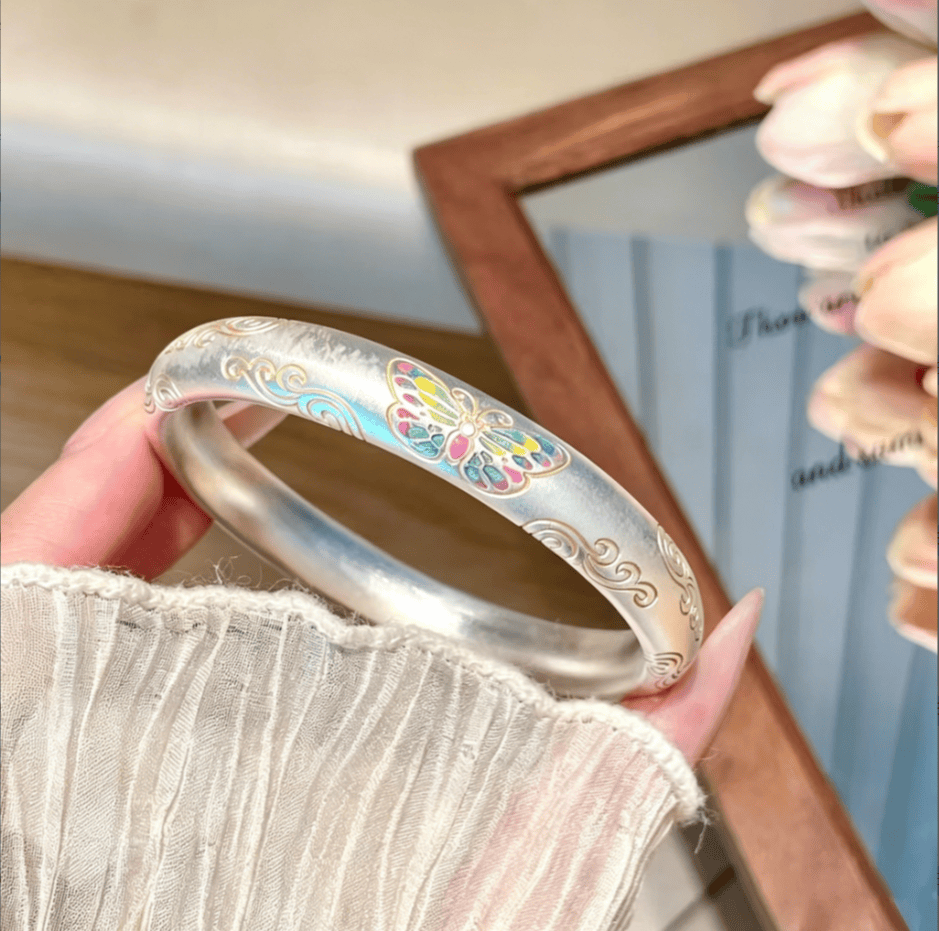
Butterfly
The butterfly has several layers of meaning.
The character 蝶 (dié) is pronounced like 耋 (dié), an old term associated with a person of advanced age, traditionally around eighty. This created an association between the butterfly and longevity.
Butterflies can also symbolize beauty, love and happiness in Chinese decorative art.
In Miao culture, however, the butterfly carries an additional and much deeper meaning: the Butterfly Mother is an important ancestral figure in Miao traditional culture. This is a specifically Miao cultural interpretation and should not be treated as the universal meaning of butterflies throughout China.
Longevity lock
The longevity lock (长命锁) is a traditional children’s ornament, often made of silver. It is worn as a blessing for a child’s health, safety and long life.
Traditional examples may carry inscriptions such as 长命富贵 (“long life and prosperity”) or 长命百岁 (“may you live to one hundred”), sometimes accompanied by auspicious animals or other protective motifs. Customs surrounding who gives the lock and when it is worn vary from place to place.
Buddhist characters and mantras
Some Chinese silver jewellery incorporates Buddhist mantras, sacred Sanskrit characters or Buddhist symbols. These are worn as expressions of faith, protection or spiritual blessing.
The exact inscription varies from piece to piece, so it is better not to assume that every piece uses the same mantra.
Cloud motifs
Cloud patterns are among the most common auspicious decorative elements in Chinese art. Clouds are associated with the heavens, rain and auspiciousness, and they often fill the spaces around animals, flowers, deities or other central motifs.
Peach and crane
The peach is strongly associated with longevity through the traditional story of the peaches of immortality.
The crane is another classic longevity symbol. Together, peach and crane create an especially clear birthday or longevity blessing.
Character, purity and good qualities
Lotus
The lotus is admired for growing from muddy water while producing a clean and beautiful flower. It therefore became an important symbol of purity and moral integrity, especially within Buddhist culture.
It also participates in Chinese wordplay. When combined with fish, for example, lotus and fish can suggest 连年有余 — “surplus year after year”, using the sound of lián (“lotus,” 莲) with lián (“continuously,” 连) and yú (“fish,” 鱼) with yú (“surplus,” 余).
Plum blossom
Plum blossoms appear while winter is still present, making them a traditional symbol of resilience, endurance and dignity in difficult conditions.
Bamboo
Bamboo is associated with strength, flexibility, integrity and the qualities of a cultivated or principled person. Its ability to bend without easily breaking has made it a particularly enduring symbol.
Peony
The peony is one of the strongest traditional symbols of wealth, honour and prosperity. Its large, abundant flowers also make it naturally suited to luxurious decorative designs.
Love, marriage and family
Paired motifs
Pairs are common in Chinese auspicious art, especially when the subject is marriage or companionship.
Two fish, paired birds or mandarin ducks can express togetherness and harmony. But the meaning comes from the particular motif as well as from the pairing, so there is no single rule that every pair of objects has the same meaning.
Mandarin ducks
Mandarin ducks are traditionally associated with love, marital harmony and devotion. A pair of them is therefore a classic wedding motif.
Pomegranate
A pomegranate contains a great many seeds, which led to its association with fertility, children and a flourishing family line. Pomegranate motifs are therefore especially common in designs expressing wishes for many descendants.
Carp leaping the Dragon Gate
The carp leaping over the Dragon Gate comes from a famous Chinese legend in which a carp succeeds in crossing the Dragon Gate and transforms into a dragon.
The image therefore represents perseverance, achievement and success. Historically, it has also been associated with success in examinations and advancement in life.
Horse
The horse can express speed, achievement and success.
The familiar expression 马到成功 (mǎ dào chénggōng) means roughly “success upon arrival,” making the horse a popular motif for someone beginning a new venture or hoping for quick success.
Modern motifs on traditional metal
Not every symbol found on contemporary Chinese-inspired jewellery is centuries old.
Modern designers sometimes use forms such as the Möbius band to suggest eternity, continuity or an unbroken relationship. Four-leaf clovers may similarly retain their familiar Western symbolism.
These newer motifs can sit alongside traditional Chinese symbols because jewellery has always been capable of carrying personal wishes. What changes is the visual vocabulary used to express them.
How motifs combine
One of the most interesting features of Chinese decorative art is the way individual motifs can be combined to create a more specific message.
- Lotus + fish → lián nián yǒu yú, “surplus year after year”
- Bat + longevity symbol → blessings and long life
- Peach + crane → longevity
- Gourd + vines or fruit → prosperity, fertility and generations of descendants
- Mandarin ducks + lotus → marital harmony and affection
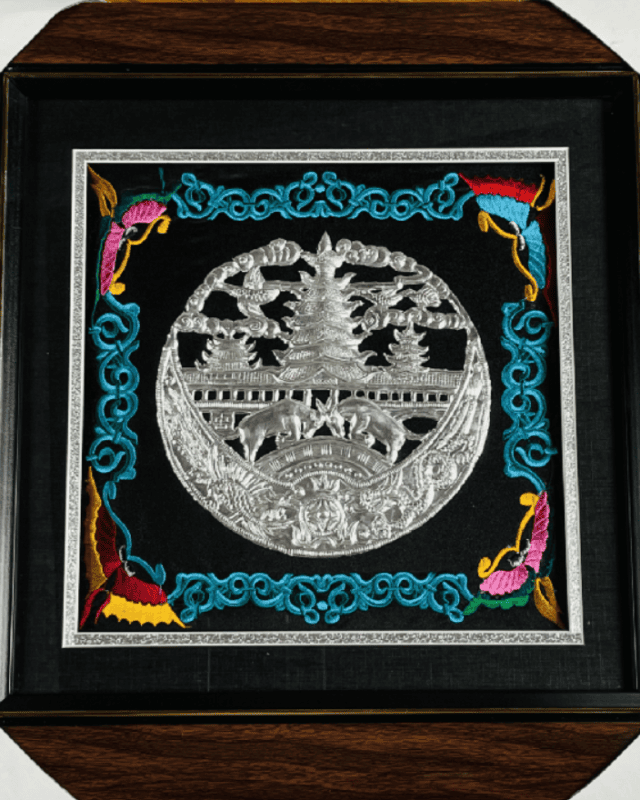
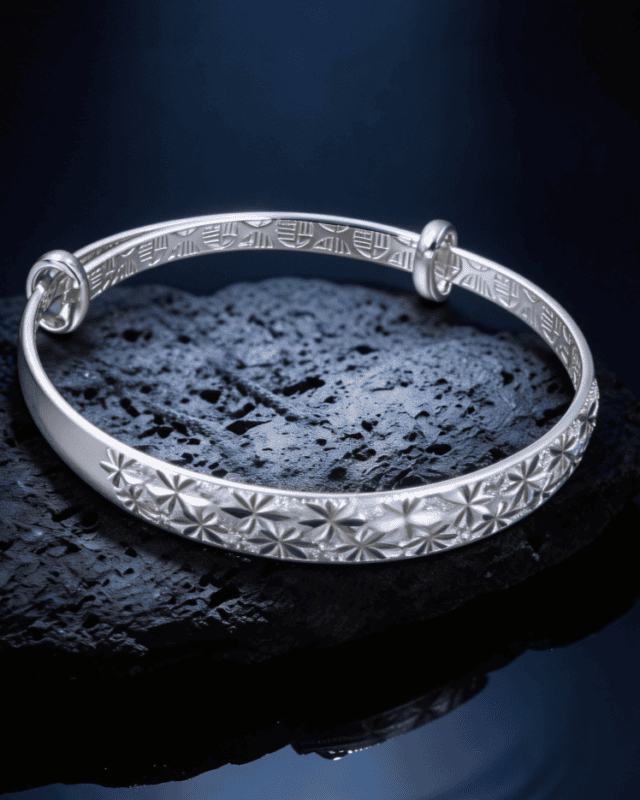
Traditional artists could therefore build a visual “sentence” from several familiar symbols. A heavily decorated bangle or relief panel may not be depicting a single scene at all. It may be bringing several good wishes together in one object.
Choosing jewellery with the meaning in mind
Symbolism can be a useful way to choose a meaningful gift.
For a new baby, a silver longevity lock or a simple protective motif can express wishes for health and a long life.
For someone starting a business, coins, an abacus or Pixiu may be appropriate.
For someone who values integrity and resilience, bamboo, plum blossom or lotus can carry a more personal message.
For a couple, paired motifs or mandarin ducks can express companionship and harmony.
But the most important thing is not to treat these meanings as a fixed dictionary. Chinese symbolism has developed over centuries and varies across regions, artistic traditions and communities. A motif may carry several meanings at once.
Browse the silver collection with this vocabulary in mind, and the pieces begin to look less like a collection of shapes and more like a collection of wishes.
For more about the cultural background and craftsmanship behind Miao silver, see Miao silver jewellery.