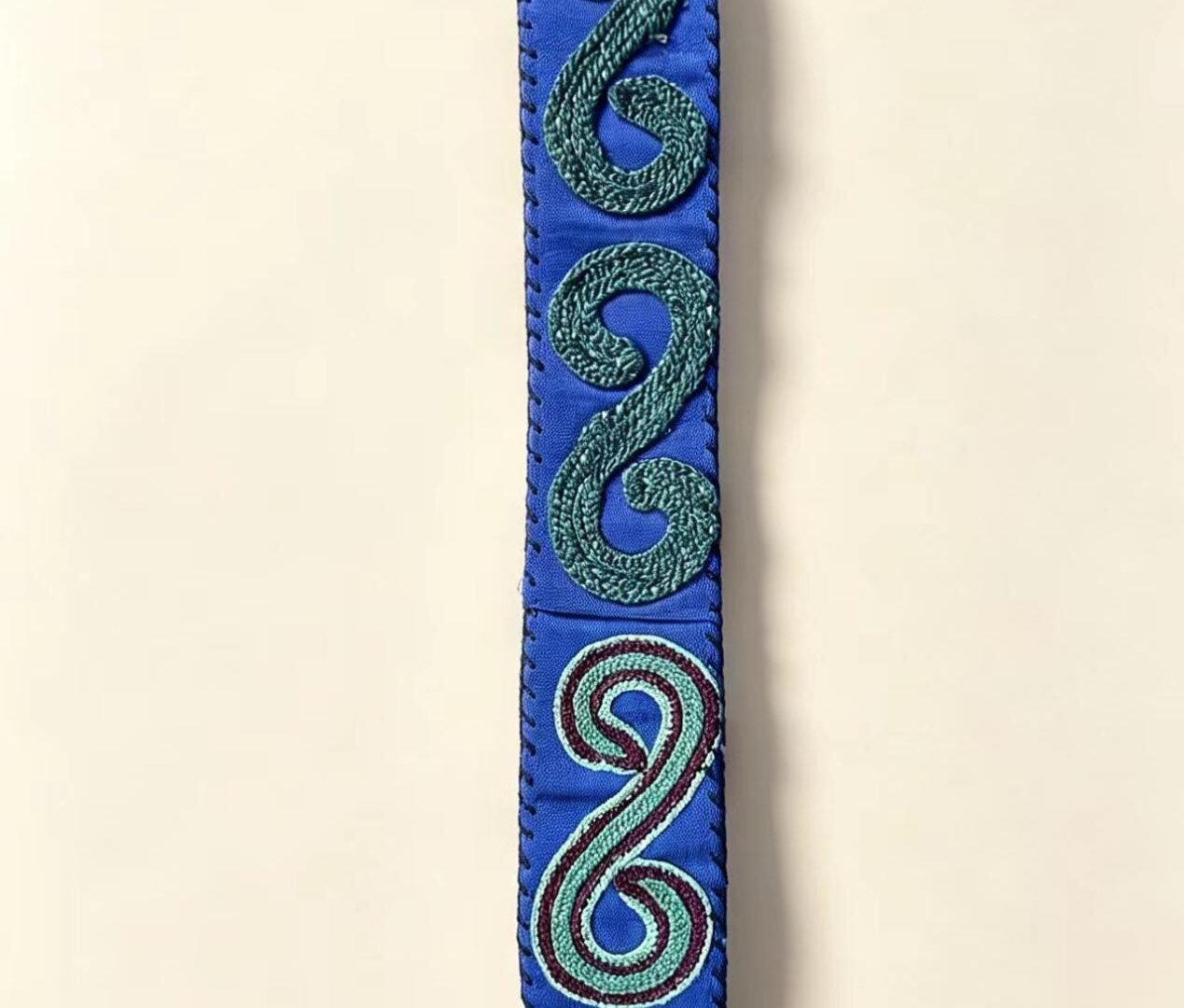
Miao embroidery is more than decoration. Across southwestern China, embroidered clothing has long served as a visual language, carrying stories, symbols and memories from one generation to the next.
The meaning of a motif, however, is not always universal. Miao communities are diverse, and the same animal, geometric form or colour may have different interpretations in different places. It is therefore better to read Miao embroidery as a collection of regional traditions rather than as one fixed symbolic system.
Cloth as a record of memory
Miao oral traditions include stories that tell of an earlier written tradition being lost during periods of migration and upheaval. What remained, in many communities, was carried through oral storytelling, song, dress and embroidery.
This is why Miao clothing is sometimes described as a “history without writing” or an “unwritten history”. In places such as Taijiang in Guizhou, traditional clothing and embroidery patterns are closely connected with community identity and memories of migration.
Because these traditions were transmitted mainly through families and communities, patterns developed differently from one region to another. A motif should therefore be understood in the cultural context in which it was made.
Motifs that appear again and again
Butterfly Mother
Butterfly Mother, or Mother Butterfly, is one of the most important figures in widely known Miao creation traditions. She is closely associated with the maple tree and with stories about the origins of life and the Miao people.
Her image may appear as a recognisable butterfly or in highly abstract geometric forms. The motif can express ideas of ancestry, life, fertility and continuity, although the exact interpretation varies between communities.
The maple tree
The maple tree is closely connected with Butterfly Mother in Miao creation traditions. It may therefore appear not simply as a botanical image, but as a symbol connected with origins, life and protection.
The dragon
Miao dragon imagery is different from the imperial dragon associated with Chinese court art. In different local traditions, the Miao dragon can be linked with rain, protection, fertility, strength and auspiciousness.
Its form is often imaginative rather than zoological: a dragon may combine features associated with fish, birds, animals or other creatures.
Fish, flowers and plants
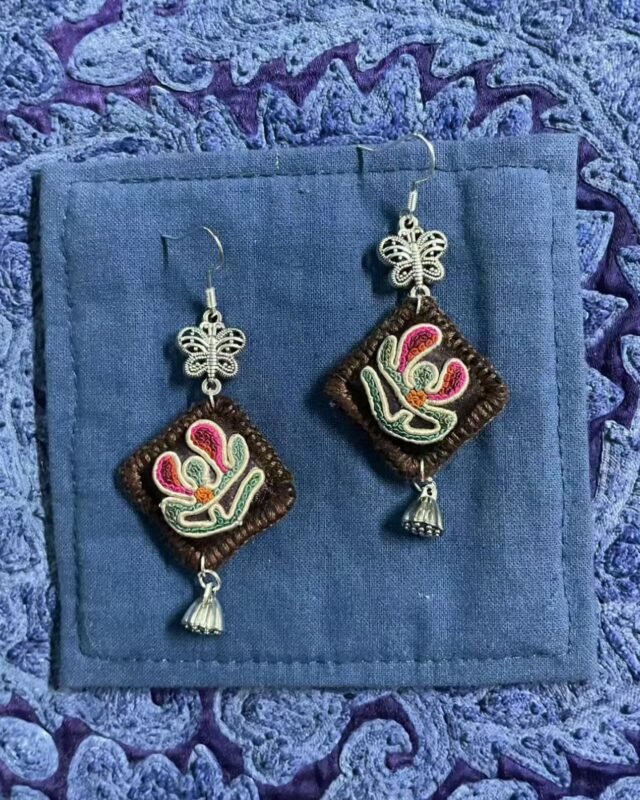
Fish, pomegranates, flowers and other life-giving motifs can carry associations with fertility, abundance and family continuity in some regional traditions.
But there is no single Miao dictionary in which every fish or flower has one fixed meaning. The surrounding motifs, the community, the garment and the occasion all matter.
Birds and buffalo
Birds are common in Miao visual traditions, sometimes appearing alongside butterflies, dragons, flowers and other creatures.
The buffalo also has an important place in many Miao communities, particularly those whose traditional agricultural life depended on buffalo and rice cultivation. Buffalo imagery can therefore connect embroidery with farming, ritual life and prosperity.
The patterns of migration
One of the most fascinating traditions associated with Miao clothing is the idea that embroidered bands can preserve memories of ancestral migration.
In some communities, horizontal bands on skirts, sleeves or panels are traditionally interpreted as rivers, mountains, fields or places associated with the journey south. Particular colours or lines may be explained as representing specific rivers or landscapes.
But these interpretations are not identical everywhere. For example, traditions recorded in different parts of Guizhou associate bands with different combinations of the Yellow River, Yangtze, Jialing River, Wu River or other waterways.
The important point is not that every line can be translated into the name of a particular river. It is that clothing can function as a carrier of collective memory — a way of remembering where a community believes its ancestors came from and the landscapes associated with that journey.
Indigo and the cloth beneath the embroidery
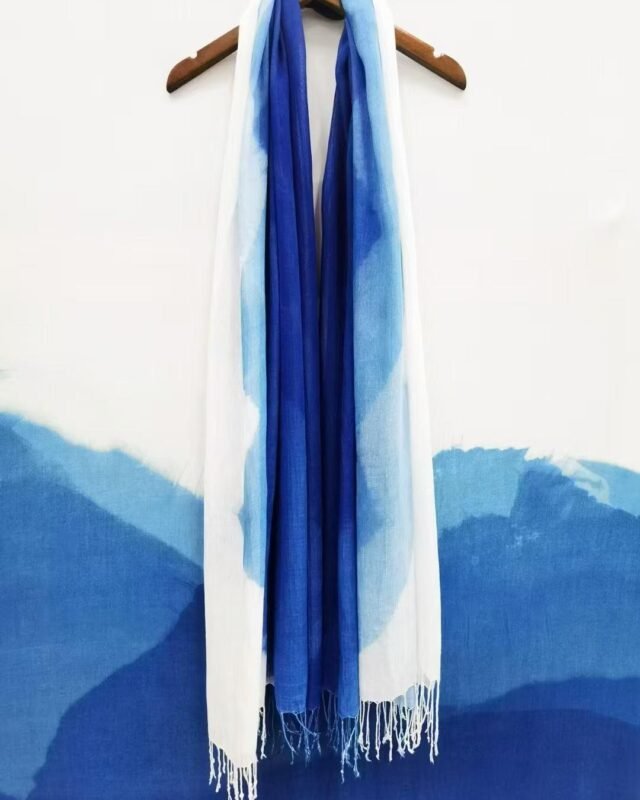
Indigo is strongly associated with many Miao textile traditions in Guizhou. Cotton cloth may be repeatedly immersed in an indigo dye bath, removed, exposed to air and dyed again until the desired depth of colour is achieved.
Some garments combine indigo dyeing with wax-resist dyeing. In this process, wax is applied to selected areas before the cloth is dyed. When the wax is removed, the protected areas remain lighter, creating the characteristic contrast of batik.
Another distinctive material is glossy indigo cloth, often called liangbu (亮布). Its production varies considerably from one locality to another. Depending on the community, finishing materials can include egg white, animal blood, plant preparations or hide glue, followed by repeated beating, drying and sometimes further dyeing.
The result is a firm, dark cloth with a distinctive sheen, often used for ceremonial clothing and as a ground for embroidery.
The stitches
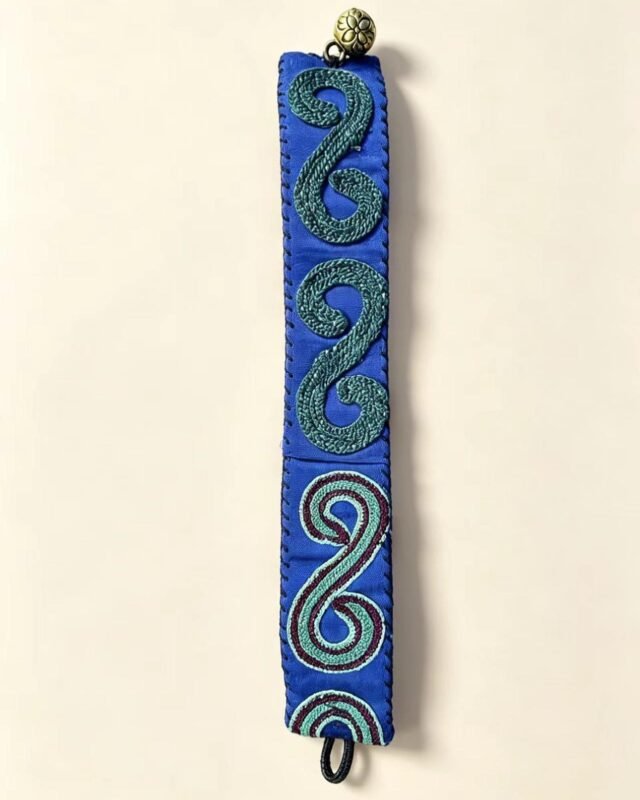
Miao embroidery is not one technique but a large family of regional practices. Several techniques may appear on the same garment.
- Braid stitch (辫绣) — silk threads are first formed into narrow braids and then attached to the cloth to create raised outlines and decorative forms.
- Split-thread embroidery (破线绣) — a silk thread is divided into several finer strands, allowing detailed and closely controlled stitching. In some Leishan traditions, a single silk thread may be divided into many fine strands before stitching.
- Counted-thread embroidery — patterns are built by counting the threads of the ground cloth, making it particularly suitable for geometric designs.
- Flat embroidery — smooth areas of colour are built up with closely placed stitches.
- Pleated or crinkled embroidery (皱绣) — fabric is gathered or manipulated before being secured with stitching, creating a more textured surface.
- Appliqué — pieces of cloth are cut, layered and stitched onto the ground to build shapes and patterns.
This mixture of techniques gives Miao embroidery much of its visual depth. A richly worked garment can combine flat surfaces, raised braids, geometric counted patterns and layered appliqué within a single composition.
Who makes it, and how long does it take?
Women have traditionally been the principal bearers of Miao embroidery knowledge. In some communities, girls began learning textile and embroidery skills at a young age, gradually making their own clothing and ceremonial pieces.
The amount of work involved can be enormous. Traditional bridal clothing in some communities could take several years to complete, with embroidery forming only one part of a much larger process that also included spinning, weaving, dyeing, cutting and sewing.
Older embroidered clothing may also be repaired, altered or repurposed rather than discarded. A section of an old garment can become a panel, bag, belt or other smaller object.
For collectors, one useful question is whether a piece is newly embroidered, made from older textile, or reconstructed from vintage clothing.
Caring for indigo and vintage embroidery
- Expect some colour transfer. Traditionally dyed indigo can rub off, especially when the cloth is new or damp. Keep it away from pale furniture and light-coloured clothing.
- Wash as little as possible. If washing is appropriate, use cool water and a mild detergent, and wash the piece separately.
- Never bleach. Strong detergents and bleaching agents can damage both the dye and delicate fibres.
- Avoid prolonged sunlight. Direct sunlight can gradually fade indigo and weaken old silk.
- Treat vintage pieces as textiles. Old silk, braid and appliqué can be fragile. Spot cleaning is often safer than immersing the whole piece.
- Store carefully. Keep valuable textiles flat where possible, with acid-free tissue between folds, and avoid damp or poorly ventilated storage.
Indigo is expected to change with age. It can soften and lighten on areas that are frequently handled while remaining deeper in protected folds. On a garment that has been worn for years, those changes become part of its history.
That is not necessarily a defect. It is evidence that the cloth has lived.
The beauty of Miao embroidery lies partly in this combination of image and memory: the needle does not simply decorate the cloth. It gives stories, identities and inherited ideas a physical form.